AMH Levels in PCOS: What Do They Mean for Fertility and Pregnancy Chances?
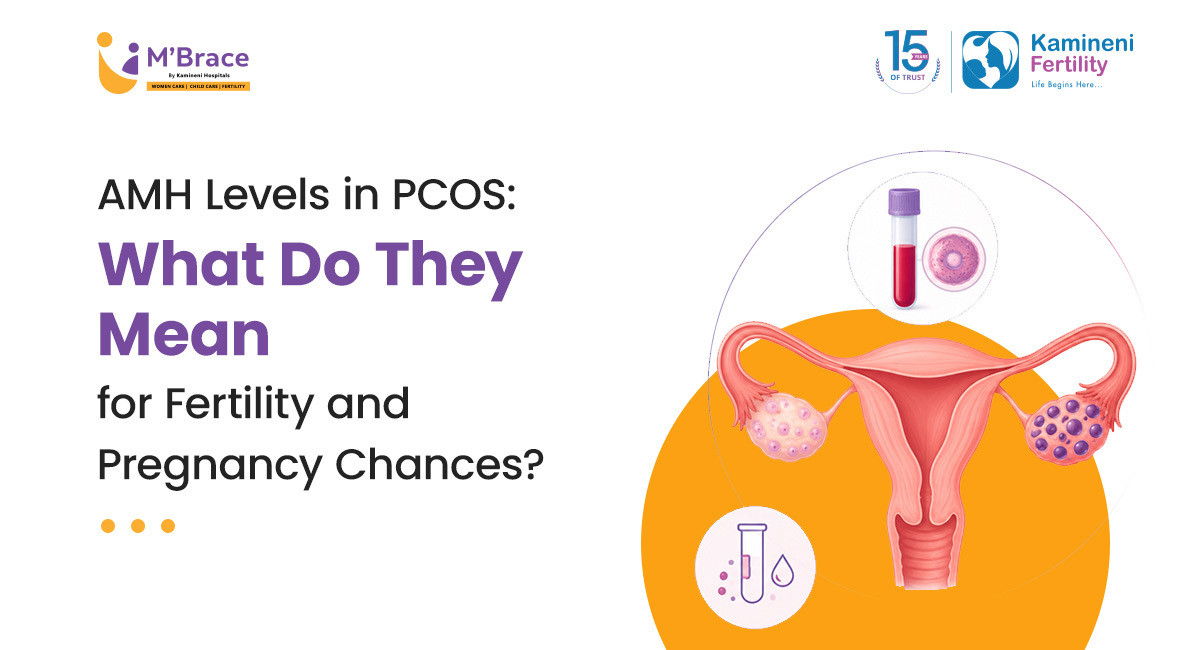
If you have PCOS and your blood test shows a high AMH value, it can feel confusing. Many women are told that AMH reflects egg reserve, so a high number should sound reassuring. But with PCOS, AMH needs a little more context.
AMH, or Anti-Mullerian Hormone, is produced by small growing follicles in the ovaries. Women with PCOS often have more small follicles than usual, so their AMH levels are commonly higher. This does not automatically mean better fertility, and it does not mean pregnancy is impossible either.
At Kamineni Fertility, our fertility specialists look at AMH along with your cycle pattern, ultrasound findings, ovulation, hormone profile, age and partner's semen analysis. A single AMH report can guide the next step, but it should not be used alone to predict your pregnancy chances.
What Is AMH?
AMH is a hormone released by tiny follicles in the ovaries. These follicles contain immature eggs. Because AMH reflects the number of small follicles present, doctors often use it as one marker of ovarian reserve.
In fertility evaluation, AMH helps doctors understand how the ovaries may respond to treatment. A low AMH may suggest reduced ovarian reserve. A high AMH may suggest a higher number of small follicles, which is frequently seen in PCOS.
Why Are AMH Levels Often High in PCOS?
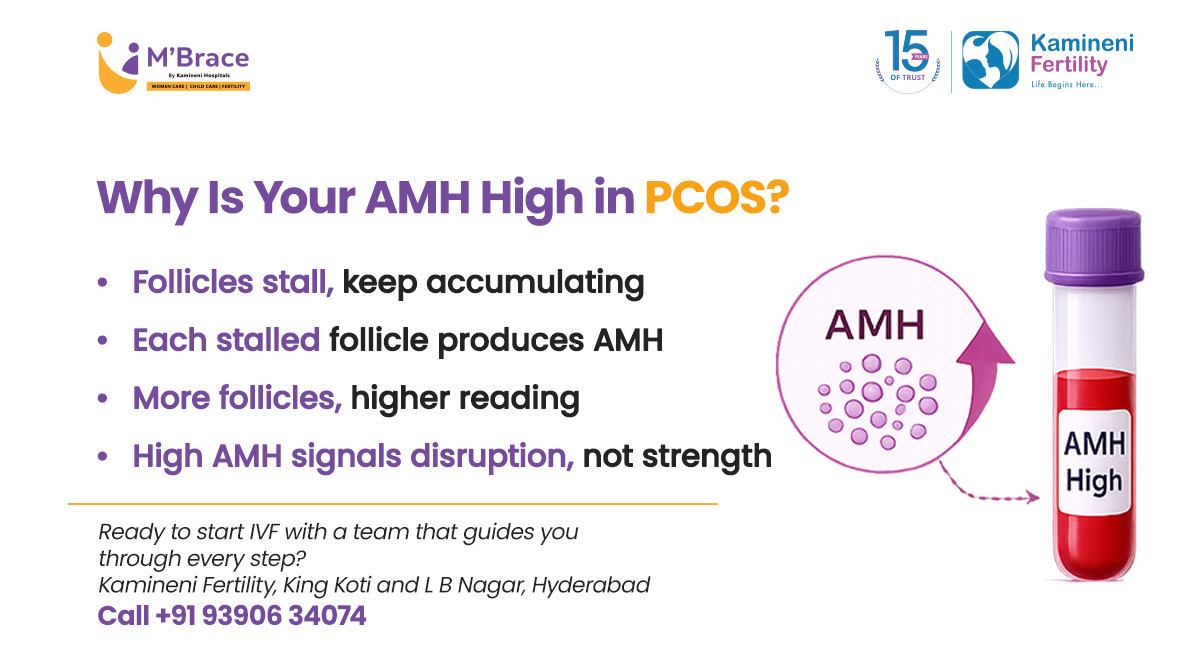
PCOS is commonly associated with many small follicles in the ovaries. Each of these follicles can produce AMH. When there are more small follicles, the AMH level can rise.
High AMH in PCOS is not the same as having many mature eggs ready for pregnancy. It usually means the ovaries contain many immature follicles, but ovulation may still be irregular or absent. That is why some women with high AMH still struggle to conceive naturally.
What AMH Levels May Mean in PCOS
AMH values can vary by lab, age and testing method. Your doctor is the right person to interpret your report, but the table below gives a simple overview.
| AMH Pattern | What It May Suggest | What It Means for Fertility |
|---|---|---|
| Low AMH | Lower ovarian reserve | May need timely fertility planning and specialist guidance. |
| Normal AMH | Expected ovarian reserve for age | Pregnancy chances still depend on ovulation, tubes, sperm and age. |
| High AMH | Often seen in PCOS due to multiple small follicles | May be linked with irregular ovulation, but treatment can help. |
Does High AMH Mean Better Fertility?
Not always. High AMH can mean the ovaries have a good number of small follicles, but fertility depends on whether an egg is released regularly and whether it can meet healthy sperm in the right conditions.
In PCOS, the main issue is often ovulation. If periods are irregular, ovulation may not happen every month. That can reduce natural pregnancy chances even when AMH is high.
Can You Get Pregnant Naturally with High AMH and PCOS?
Yes, many women with PCOS and high AMH can conceive naturally, especially if they ovulate regularly or respond well to lifestyle changes and ovulation support. However, if your periods are very irregular, cycles are long, or you have been trying for several months without success, it is better to get evaluated early.
Age also matters. AMH tells us about quantity, not egg quality. Egg quality is strongly influenced by age, so a high AMH value should not delay fertility planning if you are ready to conceive.
How AMH Helps in Fertility Treatment Planning
For women with PCOS, AMH can help the doctor plan treatment more carefully. It gives an idea of how strongly the ovaries may respond to medicines used for ovulation induction, IUI or IVF.
| Treatment Step | How AMH Helps |
|---|---|
| Ovulation induction | Helps decide medicine dose and monitoring frequency. |
| IUI | Helps reduce the chance of over-response when stimulating the ovaries. |
| IVF | Helps design a safer stimulation protocol and lower the risk of ovarian hyperstimulation. |
Women with PCOS and high AMH may be more sensitive to fertility medications. This is why individualised dosing and ultrasound monitoring are important. The goal is not to produce the highest number of follicles; the goal is a healthy, controlled response.
AMH, PCOS and IVF: What to Know
High AMH in PCOS can mean a strong response during IVF stimulation. This can be useful because doctors may retrieve a good number of eggs. But it also means the treatment plan must be carefully monitored to avoid an excessive ovarian response.
With the right protocol, IVF can be planned safely for many women with PCOS. Your specialist may adjust medication dose, choose a suitable trigger injection and recommend embryo freezing in selected cases if it improves safety.
When Should You Check AMH?
Your doctor may recommend AMH testing if you have:
- Irregular periods or suspected PCOS
- Difficulty conceiving despite trying naturally
- A history of ovarian cysts or polycystic ovaries on scan
- Previous poor or excessive response to fertility medicines
- Plans for IVF, IUI or egg freezing
AMH can be checked on any day of the menstrual cycle, but your doctor may combine it with other tests depending on your symptoms and fertility goals.
Other Tests That Matter Along with AMH
AMH is useful, but it is only one part of fertility assessment. For PCOS, your doctor may also recommend:
- Pelvic ultrasound to check follicle count and ovarian appearance
- LH, FSH, TSH, prolactin and androgen hormone tests
- Blood sugar and insulin resistance evaluation
- Ovulation tracking through scans or blood tests
- Semen analysis for the male partner
- Tube evaluation if pregnancy has not happened after repeated attempts
How Can Pregnancy Chances Improve in PCOS?
The right treatment depends on your age, weight, cycle pattern, how long you have been trying and whether there are other fertility factors. Common steps may include:
- Lifestyle and weight management where needed
- Ovulation induction medicines to help release an egg
- Follicle monitoring to identify the right time for intercourse or IUI
- IUI when ovulation support and sperm timing may help
- IVF when simpler treatments have not worked or when other fertility factors are present
For many women with PCOS, the key is restoring predictable ovulation. Once ovulation is managed well, pregnancy chances can improve significantly.
When Should You Meet a Fertility Specialist?
Consider seeing a fertility specialist if:
- Your periods are irregular or absent
- You have been trying to conceive for 6 to 12 months without success
- You are above 35 and planning pregnancy
- Your AMH is very high or very low
- You have had repeated miscarriages or failed treatment cycles
Early evaluation does not always mean you need IVF. It means you get clarity on what is causing the delay and which treatment is most appropriate for you.
Get PCOS Fertility Guidance at Kamineni Fertility
AMH levels in PCOS can be reassuring, confusing or worrying depending on how they are explained. At Kamineni Fertility, our specialists interpret your AMH report in the context of your complete fertility health, not as an isolated number.
As one of the best fertility hospitals in Hyderabad, Kamineni Fertility offers PCOS evaluation, ovulation induction, IUI, IVF and personalised fertility care at King Koti and L B Nagar. Our team helps you understand your reports, your options and your realistic pregnancy chances.
If you have PCOS, irregular periods or a high AMH report and want to plan pregnancy, book a consultation with our fertility specialists.
- King Koti Branch: 4-1-1226, Boggulakunta, King Koti, Abids, Hyderabad - 500001
- L B Nagar Branch: OP No. 8, Kamineni Hospitals, L B Nagar, Hyderabad - 500068. Accessible via L B Nagar Metro Station.
- Call us: +91 93906 34074
Book your fertility evaluation at Kamineni Fertility and take the next step with a clear, personalised plan.
Disclaimer: This content is for informational purposes only and does not replace medical advice. Please consult a qualified fertility specialist for personalised guidance on PCOS, AMH interpretation and fertility treatment.
Frequently Asked Questions
Is high AMH common in PCOS?
Yes. Many women with PCOS have high AMH because their ovaries contain more small follicles. This is one reason AMH is often considered alongside ultrasound findings when PCOS is suspected.
Does high AMH mean I can get pregnant easily?
Not necessarily. High AMH may indicate more small follicles, but pregnancy depends on regular ovulation, egg quality, sperm health, fallopian tubes and age. In PCOS, irregular ovulation can make natural conception harder.
Can AMH diagnose PCOS?
AMH can support the evaluation, but PCOS is usually diagnosed using a combination of cycle history, symptoms, hormone tests and ultrasound findings. Your doctor should interpret AMH with the full clinical picture.
Can high AMH affect IVF treatment?
Yes. Women with PCOS and high AMH may respond strongly to stimulation medicines. This can be helpful, but it also requires careful dosing and monitoring to reduce the risk of ovarian hyperstimulation.
When should I visit Kamineni Fertility for PCOS?
You should visit if your periods are irregular, you have been trying to conceive without success, your AMH report is high or low, or you want a personalised pregnancy plan for PCOS. Call +91 93906 34074 to book your consultation.
Click Here to get more information on:
PCOS Fertility Treatment
Book Your Fertility Evaluation
For inquiries/ appointment, call us on:
 +91 93906 34074