How to Find Your Fertile Window: Best Days to Conceive Naturally
Most women trying to conceive are timing it on the wrong days. Not because they are not paying attention. The advice they have been given, try around day 14 and follow your app, is too general to be accurate for most cycle lengths.
The app gives you a range. Most people pick somewhere in the middle. Neither of those is precise enough.
This guide skips the basics you already know and gets straight to what you actually need: how to calculate your window for your specific cycle, what signs to look for so you know it is here right now, and which exact days within that window give you the best chances.
At Kamineni Fertility, our specialists at King Koti and L B Nagar in Hyderabad provide cycle monitoring and ovulation evaluation for women who want a clear, clinical picture of when and how they ovulate. As an ICMR-recognised fertility centre with 15+ years of experience and 17,000+ cases handled, we bring the same precision to every stage of your fertility journey, including the very first one.
How Do You Actually Calculate Your Fertile Window?
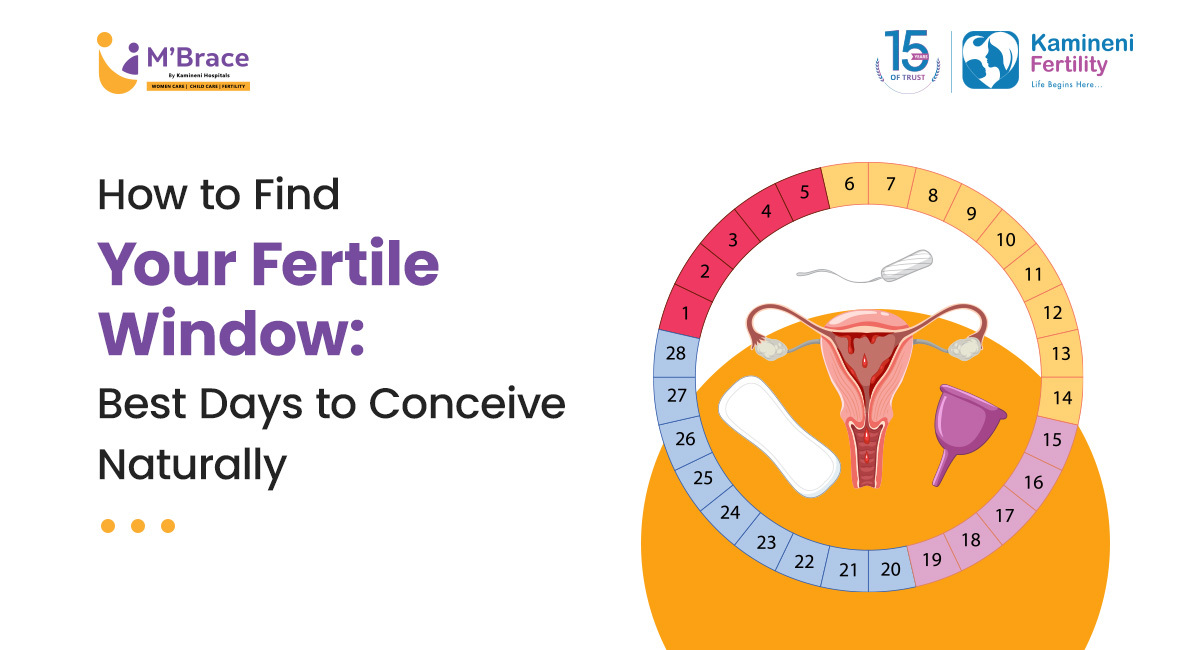
Your fertile window opens five days before ovulation and closes on ovulation day itself. That is six days total. To find it, you first need to know when you ovulate. Any fertility window calculator, including app-based ones, does this the same way: it uses your cycle length to estimate ovulation day and counts back from there.
The Formula That Works for Any Cycle Length
Ovulation happens approximately 14 days before your next period starts, not 14 days after your last period began. That distinction matters enormously for anyone whose cycle is not exactly 28 days.
The formula: your cycle length minus 14 = the day you likely ovulate.
From there, count back five days. That is when your fertile window opens.
| Cycle Length | Ovulation Day | Fertile Window |
|---|---|---|
| 24 days | Day 10 | Days 5 to 10 |
| 26 days | Day 12 | Days 7 to 12 |
| 28 days | Day 14 | Days 9 to 14 |
| 30 days | Day 16 | Days 11 to 16 |
| 32 days | Day 18 | Days 13 to 18 |
| 35 days | Day 21 | Days 16 to 21 |
If your app has been telling you to try around day 14 and your cycle is 32 days, you have been trying four days too early. That is a common reason timing alone does not work.
What If Your Cycle Changes Length Every Month?
The calendar formula only works if your cycle is consistent month to month. If your cycle varies by more than a few days, say 27 days one month and 33 days the next, the calculation gives you a different answer every cycle and becomes unreliable.
For irregular cycles, tracking physical signs is far more accurate than any calendar-based method, including apps. The next section covers exactly what to track and how.
What Are the Signs Your Fertile Window Has Arrived?
Your body produces fertile window symptoms every cycle. Most women notice them once they know what to look for. Three signs are reliable enough to use. One is the most accurate of all.
The Discharge Change
This is the most reliable physical sign of your fertile window and the one most women do not realise they have been seeing for years.
Throughout your cycle, vaginal discharge changes in texture and appearance. In the days approaching ovulation, it becomes clear, wet and stretchy, similar to raw egg white. You can stretch it between two fingers without it breaking. It feels slippery, almost like gel.
This type of discharge, which doctors call cervical mucus, appears because your body is creating the ideal environment for sperm to travel. When you see it, your fertile window is open. The two or three days when this discharge is at its most wet and stretchy are typically your most fertile days.
After ovulation, it thickens and becomes cloudy or disappears. That is the sign the window has closed for that cycle.
The Temperature Shift
Every morning before you get out of bed, your body temperature sits at its lowest point for the day. This is called your basal body temperature (BBT). Around ovulation, it rises slightly, usually by 0.2 to 0.5 degrees Celsius, and stays elevated for the rest of your cycle.
The rise confirms that ovulation has occurred. The problem is that it tells you after the fact. By the time your temperature goes up, your fertile window is closing.
BBT tracking works best when you do it for two to three cycles to spot your personal pattern. Once you know that your temperature typically rises on day 16, for example, you can use that information to time the current cycle better.
A digital thermometer designed for BBT tracking gives you the precision you need. A standard thermometer does not show changes small enough to be useful.
The LH Surge on an Ovulation Kit
Ovulation predictor kits (OPKs) detect a hormone called luteinising hormone (LH), which surges in your blood 24 to 36 hours before you ovulate. A positive result on the kit tells you ovulation is coming soon, not that it has happened.
This is the most actionable sign of the three. Unlike discharge, which requires some interpretation, or BBT, which confirms ovulation after it has passed, an OPK positive tells you the window is opening right now.
Start testing from about four days before your calculated ovulation day. Test at the same time each day, ideally between 10am and 8pm rather than first thing in the morning, because LH builds up through the day.
| Sign | When It Appears | How Reliable | What to Do When You See It |
|---|---|---|---|
| Stretchy clear discharge | 1 to 5 days before ovulation | High | Start trying now |
| LH surge on OPK | 24 to 36 hours before ovulation | High | Try today and tomorrow |
| BBT rise | Day of or after ovulation | Confirms after the fact | Use to plan next cycle |
Which Days Within the Window Are Actually Best?
The two days immediately before ovulation. Not ovulation day. Not the day after. This is the answer most women do not have and it explains a lot.
Why Sperm Survival Changes Everything?
Sperm can survive inside the female reproductive tract for up to five days. The egg, once released, survives for only 12 to 24 hours.
That asymmetry changes the entire approach to timing.
If you try on ovulation day itself, sperm have very little time to reach the egg before it degrades. If you try two to three days before ovulation, sperm are already waiting in the fallopian tubes when the egg arrives. That is what gives you the best chance.
The Most Common Timing Mistake
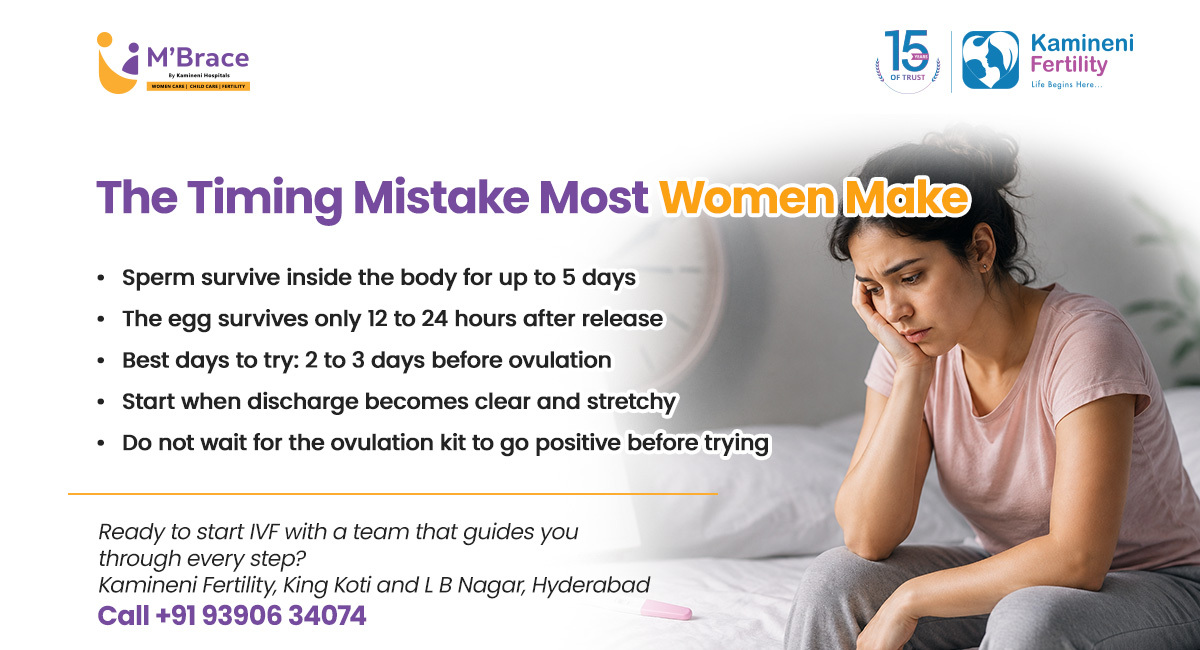
The Timing Mistake Most Women Make
- Sperm survive inside the body for up to 5 days
- The egg survives only 12 to 24 hours after release
- Best days to try: 2 to 3 days before ovulation
- Start when discharge becomes clear and stretchy
- Do not wait for the ovulation kit to go positive before trying
Contact Kamineni Fertility, Hyderabad. Call 093906 34074.
Waiting for a positive ovulation kit before starting to try. By the time that result appears, ovulation is 24 to 36 hours away. That gives you one to two attempts at most before the window closes.
Start trying when you first see the fertile-type discharge. Or three to four days before your calculated ovulation day. Do not wait for the LH surge to begin.
Your Five-Day Action Guide
| Day Relative to Ovulation | What to Do |
|---|---|
| 5 days before | Begin watching for discharge changes |
| 4 days before | Try if discharge is becoming clear and stretchy |
| 3 days before | Try. This is a high fertility day. |
| 2 days before | Try. This is the peak fertility window. |
| 1 day before | Try. LH surge likely positive today. |
| Ovulation day | Try if you have not already in the past two days |
| 1 day after | Window is closing. Egg survival is ending. |
You do not need to try every day. Every other day within the window gives you strong coverage while keeping stress and pressure manageable.
How Accurate Is Your Period App?
Honest answer: reasonably accurate if your cycle is regular, significantly less accurate if it is not.
When App Predictions Work
Period tracking apps use your cycle history to estimate when ovulation will occur. Most use the same logic as an ovulation calculator: they take your average cycle length, subtract 14 and mark the surrounding days as your fertile window. If your cycle runs to a consistent length every month and you have logged several months of data, the app's fertile window prediction is a reasonable starting point.
The keyword is starting point. Apps use averages and algorithms. They do not measure your LH, your discharge or your temperature. They estimate based on your past cycles.
When to Stop Trusting the App and Track Directly
Stop relying on app predictions alone if:
- Your cycle varies by more than five days month to month
- You have come off hormonal contraception recently and your natural cycle may not yet match your pre-pill pattern
- You have PCOS, a thyroid condition or any hormonal imbalance that disrupts regular ovulation
- You have been following app predictions for three or more cycles and it is not working
In any of these situations, tracking discharge changes and using an OPK gives you accurate, real-time information rather than a calculated estimate.
When Should You Go Beyond Timing?
You have tracked your cycle, identified your window, timed it correctly and given it several cycles. If pregnancy has not happened, timing is no longer the question. Here is when it is worth speaking to a specialist.
See a fertility specialist if:
- You are under 35 and have been trying with timed intercourse for six months without a positive result
- You are over 35 and have been trying for three to six months
- You have no clear signs of ovulation despite tracking discharge and using an OPK
- Your cycle is consistently shorter than 21 days or longer than 35 days
- Your periods are very irregular or sometimes absent altogether
- You have had two or more miscarriages
This is not a sign that something is wrong. It is information that you have done everything you can with natural timing and that a clinical picture of your cycle would now be useful.
Book a Cycle Evaluation at Kamineni Fertility, Hyderabad
If you have been using your fertility window and timing correctly and want more clarity, or if natural timing has not produced a result after the timeframes above, a cycle evaluation at Kamineni Fertility gives you a precise clinical picture of when and how you ovulate.
Our specialists at King Koti and L B Nagar in Hyderabad provide ovulation monitoring, hormonal assessment and personalised cycle evaluation. We are the best fertility centre in Hyderabad for women who want clear answers at every stage of their conception journey.
If you have been searching for a fertility clinic near me or the best fertility clinic in Hyderabad for cycle monitoring and ovulation support, both our centres are ready for you.
- King Koti Branch 4-1-1226, Boggulakunta, King Koti, Abids, Hyderabad - 500001
- L B Nagar Branch OP No. 8, Kamineni Hospitals, L B Nagar, Hyderabad - 500068. Accessible via L B Nagar Metro Station.
- Call us: 093906 34074
Book your fertility evaluation at Kamineni Fertility. Get a clear picture of your cycle and your next step.
Disclaimer: This content is for informational purposes only and does not replace medical advice. Please consult a qualified fertility specialist for personalised guidance on conception and cycle tracking.
Frequently Asked Questions
How do I find my fertile window if my cycle is not 28 days?
Subtract 14 from your cycle length to find your ovulation day, then count back five days. A 32-day cycle means ovulation around day 18.
What does fertile discharge actually look like?
Clear, wet and stretchy, similar to raw egg white. It feels slippery and you can stretch it between two fingers without it breaking.
Is the day of ovulation actually the best day to try?
No. The two days before ovulation are better. Sperm survive up to five days inside the body. The egg survives only 12 to 24 hours.
Do period tracking apps give accurate fertile window dates?
Reasonably accurate for regular cycles with several months of data. Unreliable for irregular cycles, recent contraception or conditions like PCOS.
Can I feel when I am ovulating?
Some women do notice mild sensations around ovulation: a light twinge or ache on one side of the lower abdomen, slightly increased sensitivity or a sense of fullness in the pelvic area. These are real but not universal and not reliable enough to time conception on their own. The discharge change and an OPK positive are far more consistent and actionable signals.