IVF vs Test Tube Baby: Key Difference Explained
Your doctor says IVF. Your family says test tube baby. The internet uses both.
So you end up wondering: are these two different treatments? Does one cost more? Is one safer than the other?
Here is the short answer: they are exactly the same thing. IVF is the medical name. Test tube baby is what the world called it before the medical name caught on. Same procedure, same process, same outcome.
At Kamineni Fertility, we are an ICMR-recognised IVF centre and the best IVF centre in Hyderabad, with 15+ years of experience, 17,000+ cases handled and 14,000+ babies delivered. Our specialists at King Koti and L B Nagar guide you from your very first question to a clear, honest treatment plan.
Below, we answer every question you may have about IVF vs test tube baby, in plain, simple language.
Is IVF and Test Tube Baby the Same Thing?
Yes. They are the same procedure, just different names for it.
IVF stands for In Vitro Fertilisation. "In Vitro" is Latin for "in glass." It means fertilisation that happens outside the body, in a small laboratory dish. "In vivo" means inside the body. So IVF is simply the outside-the-body version of fertilisation.
Test tube baby is a popular nickname that stuck after the first IVF baby was born in 1978. The name came from people imagining a baby being grown inside a test tube. That image was never accurate, but the phrase never went away.
So Why Is It Called a Test Tube Baby If No Test Tube Is Used?
Good question. And the answer is actually quite interesting.
When IVF was first developed, most people had never heard of it. Journalists needed a way to explain it simply. Someone used the phrase "test tube baby," the public understood it and it spread. The actual equipment used is a small flat dish called a petri dish, not a test tube. But by then, the name had already taken hold.
Today, doctors never use the term "test tube baby." It does not appear in any medical guideline or treatment record. When you speak to a fertility specialist, they will always say IVF.
What Is the Test Tube Baby Process and Is It Different From IVF?
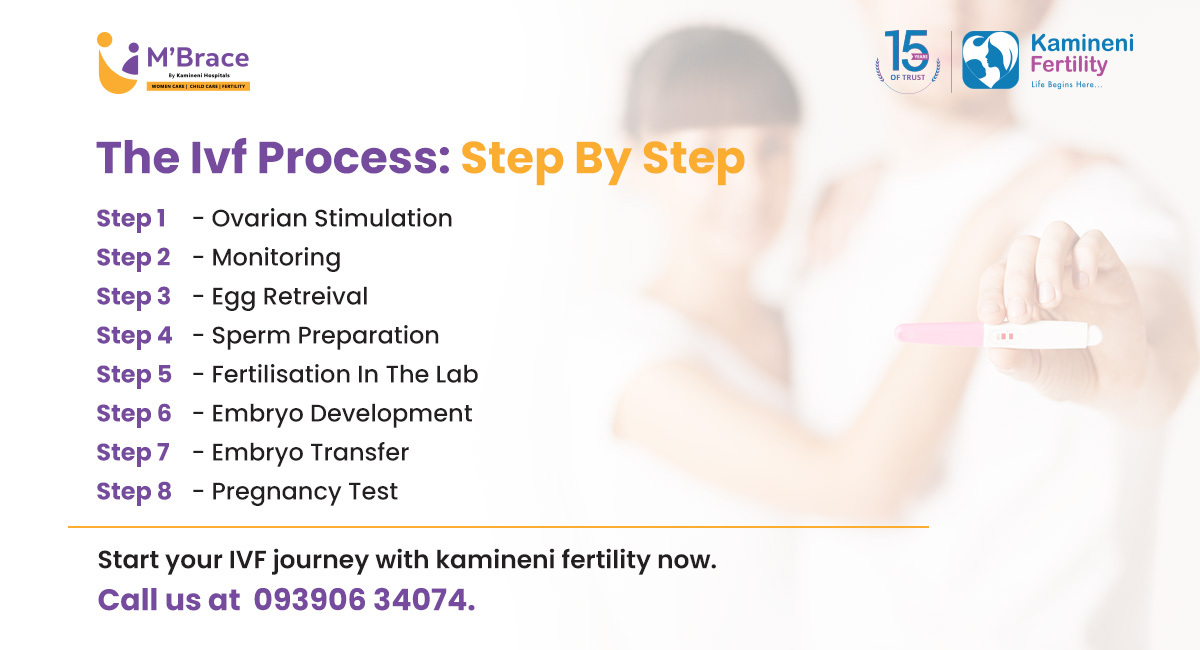
The test tube baby process and the IVF process are identical. There is no difference. Here is exactly what happens, step by step, and why each step is done.
| Stage | What Happens | Why It Is Done |
|---|---|---|
| Ovarian Stimulation | Medicines help the ovaries produce several eggs | More eggs means better chances of fertilisation |
| Monitoring | Scans and blood tests track egg growth | So retrieval happens at exactly the right time |
| Egg Retrieval | Eggs are collected under light sedation | Eggs need to be outside the body for lab fertilisation |
| Sperm Preparation | Sperm is processed to select the best quality | Improves fertilisation success |
| Fertilisation | Eggs and sperm are combined in a lab dish | This is where conception happens |
| Embryo Development | The fertilised egg is watched over 2 to 5 days | To choose the best, healthiest embryo |
| Embryo Transfer | The embryo is placed gently into the uterus | To give it the best chance of implanting |
| Pregnancy Test | A blood test is done 14 days after transfer | To confirm if the embryo has implanted |
Your doctor and embryologist guide every single step. Your treatment plan is adjusted based on how your body responds.
Does the Pregnancy After IVF Continue Naturally?
Yes. Completely.
Once the embryo implants in the uterus, everything continues as a normal pregnancy. The mother carries the baby the same way. The hormonal changes are the same. The antenatal visits are the same. The delivery is the same.
IVF is only involved in the fertilisation step. After that, it is a natural pregnancy in every sense.
IVF Baby vs Test Tube Baby vs Naturally Conceived Baby: Is There Any Difference?
No difference at all.
A baby born through IVF grows in the mother’s womb, just like any other baby. The genes come entirely from the parents. The pregnancy is natural. The birth is natural.
Many Indian families carry a quiet worry about this. Will the baby be as healthy? Will the child develop normally? Will something be different?
The answer is no, on all counts.
Research across millions of IVF births worldwide shows this clearly:
- IVF babies reach the same growth and development milestones as naturally conceived children
- Their physical health is the same
- Their cognitive development is the same
- They face no additional health risks because of how they were conceived
The only thing different about an IVF baby is the first few days of their existence. Fertilisation happened in a lab dish instead of a fallopian tube. Everything else is the same.
Is IVF or Test Tube Baby Treatment Safe?
Yes. IVF is one of the most studied medical procedures in the world.
It has been performed since 1978. Over 8 million babies have been born through IVF globally. The safety record is strong.
What Are the Risks for the Mother?
The main risk is something called Ovarian Hyperstimulation Syndrome (OHSS).
OHSS is a condition where the ovaries respond too strongly to the stimulation medicines. It causes bloating and discomfort. Most cases are mild and get better on their own. Your fertility team watches for it at every monitoring scan and adjusts your medication if needed.
Egg retrieval is a short procedure, around 20 to 30 minutes under light sedation. Most women are back to normal activity within one to two days.
Is an IVF Baby as Healthy as Any Other Baby?
Yes. Research is very clear on this.
Children born through IVF:
- Grow and develop at the same rate as naturally conceived children
- Have the same cognitive abilities
- Face no extra health risks because of IVF
The procedure affects only how fertilisation happens. It does not affect the baby’s health, intelligence or development in any way.
What Affects Whether IVF Works?
IVF does not work exactly the same way for every couple. Several things affect the outcome.
Your doctor will explain how each of these applies to your specific situation before treatment begins.
Age and Egg Quality
Age is the most important factor in IVF.
As women get older, egg quality naturally changes. This affects how well fertilisation happens and how strong the resulting embryo is. Women under 35 generally respond well to IVF. IVF is also possible for older women, but your doctor will be honest about what to expect based on your test results.
Other Factors That Matter
- Sperm quality: Count, movement and shape all affect fertilisation
- Uterine health: The lining of the uterus needs to be ready to receive the embryo
- Your diagnosis: Conditions like PCOS, endometriosis or low ovarian reserve all need specific protocols
- Embryo quality: The embryologist grades each embryo before transfer
- Lab quality: The standard of the embryology laboratory matters significantly
At Kamineni Fertility, our advanced embryology lab and experienced team ensure every embryo gets the best possible environment from fertilisation to transfer.
IVF vs Test Tube Baby: Which Term Do Doctors Use? And Does the Cost Differ?
Doctors use IVF. Always.
Test tube baby is not a clinical term. It does not appear in treatment protocols, medical records or diagnostic guidelines. When you visit a fertility specialist anywhere in India, they will use the term IVF.
Is Test Tube Baby Treatment Priced Differently?
No. Since they are the same procedure, the cost is the same.
IVF treatment cost depends on:
- The protocol your doctor recommends for your specific case
- The medications prescribed
- Whether additional procedures like ICSI or embryo freezing are needed
- The number of cycles required
At Kamineni Fertility, your specialist explains the full treatment plan and all costs transparently before anything begins. No surprises.
Why Do Indians Still Say "Test Tube Baby"?
Because it is easier to say, and it has been used in Indian homes for over 40 years.
That is completely fine. What matters is that you know both terms mean the same thing. Choosing IVF is a medical decision. It is not a sign of failure, weakness or something to feel embarrassed about.
India has been part of IVF history from the very beginning. Durga, the first reported test tube baby in India, was born in 1978, the same year as Louise Brown, the world’s first IVF baby. India was one of the first countries in the world to do this successfully.
Who Is IVF or Test Tube Baby Treatment Recommended For?
IVF is recommended when natural conception has not happened and other treatments have not worked or are not suitable. Your doctor recommends IVF based on your diagnosis and medical history, not as a default for everyone.
Conditions Where IVF Is the Right Step
- Blocked or damaged fallopian tubes
- Low sperm count, poor sperm movement or abnormal sperm shape
- Ovulation problems that do not respond to simpler treatments
- Endometriosis affecting the reproductive organs
- Unexplained infertility after a full evaluation
- Poor ovarian reserve
- Previous IUI cycles that did not result in pregnancy
When Is ICSI Added to IVF?
Sometimes IVF is combined with a technique called Intracytoplasmic Sperm Injection (ICSI). In ICSI, a single sperm is injected directly into the egg. It is recommended when sperm quality is significantly affected or when fertilisation did not happen well in a previous IVF cycle. ICSI is part of the same IVF process, not a different treatment.
Start With a Consultation at Kamineni Fertility, Hyderabad
Whether you call it IVF or a test tube baby, the science is proven, the procedure is safe and the first step is the same: a consultation with a specialist who will tell you exactly what you need, based on your situation.
Kamineni Fertility is the best IVF hospital in Hyderabad for couples who want honest, transparent and personalised fertility care.
Here is what you get when you come to us:
- 15+ years of experience in IVF treatment
- 17,000+ fertility cases handled
- 14,000+ babies delivered
- ICMR-recognised centre with advanced embryology labs
- Two easily accessible locations in Hyderabad
If you have been searching for the best IVF treatment in Hyderabad or the best IVF hospital near me, both our centres offer complete IVF treatment in Hyderabad with full support from evaluation to post-cycle follow-up.
- King Koti Branch 4-1-1226, Boggulakunta, King Koti, Abids, Hyderabad – 500001
- L B Nagar Branch OP No. 8, Kamineni Hospitals, L B Nagar, Hyderabad – 500068
- Call us: 093906 34074
Book your fertility evaluation at Kamineni Fertility. Come in with your questions. Leave with a clear plan.
Disclaimer: This content is for informational purposes only and does not replace medical advice. Please consult a qualified fertility specialist for personalised guidance on IVF treatment and outcomes.
Frequently Asked Questions
Is a test tube baby grown entirely in a laboratory?
No. Fertilisation happens in a laboratory dish, but the embryo is transferred into the mother’s uterus within days. From that point, the pregnancy develops completely naturally inside the mother’s body. The baby is not kept in any device at any stage.
What is the difference between IVF and ICSI?
IVF is the full procedure involving egg retrieval, laboratory fertilisation and embryo transfer. ICSI, or Intracytoplasmic Sperm Injection, is a technique used within IVF where a single sperm is injected directly into the egg. ICSI is recommended when sperm quality is poor or when previous IVF fertilisation was not successful. It is part of the IVF process, not a separate treatment.
How long does one IVF cycle take?
A standard IVF cycle takes around 3 to 4 weeks. Ovarian stimulation runs for 10 to 14 days with daily injections and regular monitoring. Egg retrieval happens on one day. The embryo develops for 2 to 5 days in the lab. The embryo transfer is a short, painless procedure. A pregnancy blood test is done 14 days after transfer.
Is IVF treatment available at Kamineni Fertility in Hyderabad?
Yes. Kamineni Fertility offers complete IVF treatment at our fertility hospital in Hyderabad at both King Koti and L B Nagar. Our IVF programme covers full evaluation, personalised stimulation, expert embryology and post-cycle support. Call 093906 34074 to book your consultation at the best IVF hospital near me in Hyderabad.
Click Here to get more information on:
IVF at Kamineni Fertility
Natural Cycle IVF at Kamineni Fertility
For inquiries/ appointment, call us on:
 +91 93906 34074