Best Age to Freeze Your Eggs: What Women Should Know Before 35?
You're in your late 20s or early 30s. You aren't ready for a baby yet. But relatives keep asking, and every article says "before 35." So when is the right time? The best age to freeze your eggs is usually the late 20s to early 30s. Freezing before 35 gives you the best odds. But the number of eggs you freeze matters as much as your age. Freezing at 35 to 38 can still be worth it.
At Kamineni Fertility, an ICMR-recognised fertility centre in Hyderabad, our team has 15+ years of experience. We've evaluated and treated 17,000+ couples and helped deliver 14,000+ babies at our King Koti and L B Nagar centres.
Here's what each age can really offer you, and how to tell if now is your time.
What Is the Best Age To Freeze Your Eggs?
For most women, the best window is the late 20s to early 30s, ideally before 35. Younger eggs are more likely to be genetically normal. That means they have the right genes to grow into a healthy embryo. As you get older, fewer eggs pass that test.
The numbers back this up. A 2024 review in Human Reproduction Update looked at women who came back to use their frozen eggs. About 52% of women who froze at 35 or younger had a baby. For women who froze at 40 or older, it was 19%.
So the honest answer on the best age to freeze your eggs is simple. Earlier is better, but it isn't the only thing that counts.
Why Do Frozen Eggs Stay the Age They Were Frozen At?
Clinics freeze eggs using vitrification. This is a very fast freezing method that stops ice crystals from forming. Once frozen, an egg keeps the quality it had on that day. Your body still ages, though. Your doctor will check your health again before any later pregnancy.
Can You Freeze Your Eggs Too Early?
In a practical sense, yes. Many women who freeze in their mid 20s later conceive naturally and never use their eggs. Women who freeze in their late 30s tend to come back and use them more often. For many women, the late 20s to early 30s strike a good balance. Egg quality is high, and there's a real chance you'll need them.
How Does Your Age Change What Egg Freezing Can Offer?
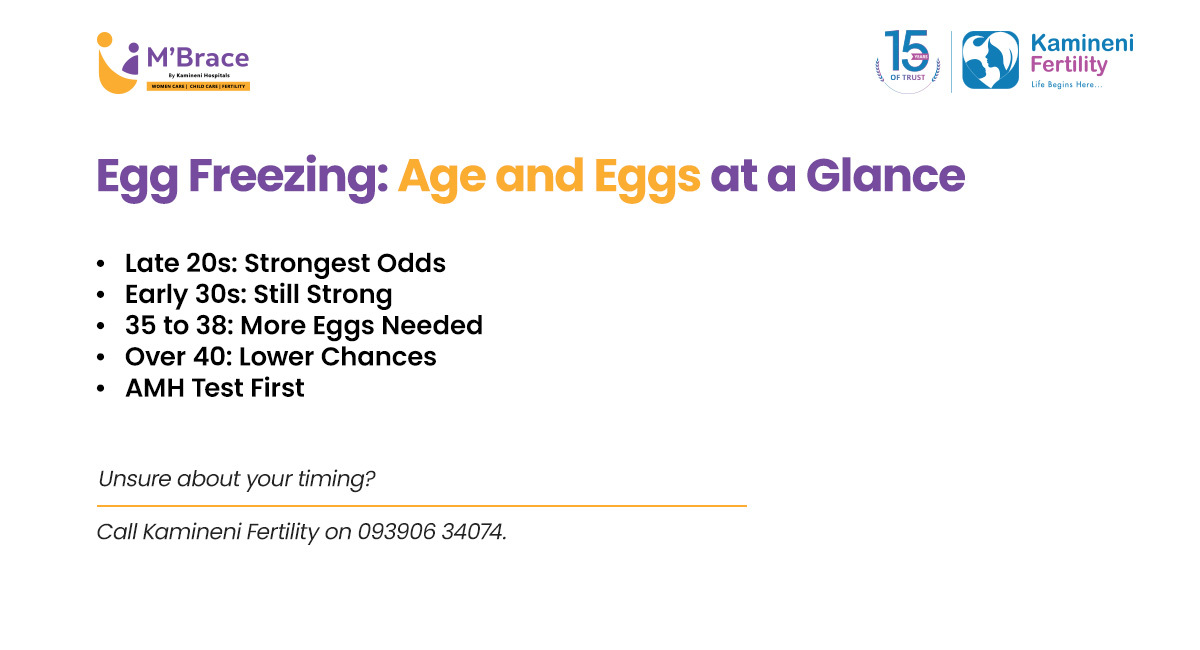
Your age changes two things at once. It changes how many eggs one cycle gives you. It also changes how many of them are likely to be healthy. Both fall with age. The drop is gentle through the early 30s, gets steeper after 35 and sharper again after 38.
| Age When Freezing | What You Can Usually Expect |
|---|---|
| Under 30 | More eggs per cycle, and a high share of healthy ones |
| 30 to 34 | Still a strong window, and one cycle may be enough |
| 35 to 37 | Quality starts to fall faster, so you may need more eggs |
| 38 to 40 | Fewer eggs per cycle, and a second cycle is common |
| Over 40 | Much lower chances, so your doctor may discuss other options |
These are general patterns from published clinical data. Your own reports may look quite different from your age group.
How Many Eggs Should You Freeze at Your Age?
More eggs give you more chances, and you need more of them as you get older. Doctors count mature eggs, the ones ready to be fertilised. Only these are frozen. Your AMH test and scan help predict how many eggs one cycle may give you.
A 2017 study in Human Reproduction looked at women who froze 20 mature eggs. It estimated their chance of at least one baby:
- Frozen at 34: About a 90% chance.
- Frozen at 37: About a 75% chance.
- Frozen at 42: About a 37% chance.
Another widely used estimate suggests women under 38 aim for 15 to 20 mature eggs. Women aged 38 to 40 may need 25 to 30. Some women need more than one cycle to reach that number.
AMH is a blood test that estimates how many eggs your ovaries still have. An antral follicle count is a scan that counts the small egg sacs in your ovaries. Together, they help your doctor plan. You can read more about oocyte freezing in Hyderabad at Kamineni Fertility.
Is It Too Late to Freeze Your Eggs After 35?
No. For many women aged 35 to 38, egg freezing is still worth it. You may need more eggs, and sometimes a second cycle, to reach the same chances. After 40, the odds fall sharply, so your doctor will talk openly about what's likely.
One number surprises most women. Women in the 2024 review who used their eggs had frozen them at 38.1, on average. If you've just turned 36 and feel you've missed the boat, you haven't. At this stage, a test tells you far more than a birthday does.
If you're married, your doctor may also discuss embryo freezing. This means fertilising your eggs with your husband's sperm before freezing them. Under the ART Act, embryos can be stored for up to ten years. They also belong to both partners, which matters if life plans change. You can learn more about our embryo freezing facilities.
Can Frozen Eggs Guarantee a Baby Later?
No. Frozen eggs give you a chance, not a promise. Some eggs don't survive thawing, some don't fertilise and some embryos won't implant. Even the American Society for Reproductive Medicine (ASRM) agrees. It says there isn't enough evidence yet to predict who will have a baby.
In the 2024 review, about 78.5% of eggs survived thawing. Across all ages, 28% of women who used their frozen eggs had a baby.
That's why honest clinics share their own data. ASRM says clinics should tell patients their own thaw and birth figures, or admit they don't have them. When you look up the best fertility clinic near me, ask each one:
- How many frozen eggs have you thawed here?
- How many of those became embryos?
- How many led to a live birth?
A clinic that dodges these questions is telling you something.
Does Egg Freezing Harm Your Health or Use Up Your Future Eggs?
Egg freezing doesn't use up eggs your body would have kept. Each month, a small group of eggs starts to grow, and all but one are normally lost. Ovarian stimulation, daily hormone shots for about 9 to 14 days, saves more of that month's group.
Northwestern Medicine, a US teaching hospital, says one cycle or even several won't make you lose eggs faster. They don't bring on an earlier menopause either. The short-term effects are real, though:
- Bloating: Your ovaries swell for a few days while the eggs grow.
- OHSS Risk: Rarely, the ovaries react too strongly to the medicines, called ovarian hyperstimulation syndrome (OHSS).
- Retrieval Discomfort: Egg collection takes a short time under sedation and may cause mild cramps or spotting.
- Quick Recovery: Most women are back to normal within 1 to 2 days.
What Does Indian Law Say About Egg Freezing Age and Privacy?
India's ART Act of 2021 lets clinics offer ART services to women above 21 and below 50. ART means fertility treatment done in a lab, and it includes egg freezing. The law covers freezing for social as well as medical reasons. It also makes clinics keep your details and treatment private.
- Age Window: Women above 21 and below 50 can use these services.
- Privacy: Your records stay private, except for the national registry, an emergency or a court order.
- Counselling: Your clinic must explain your chances, costs, side effects and risks first.
For many working women in Hyderabad, privacy is the first worry. The law is on your side. This is general information, not legal advice.
How Do You Decide If Now Is the Right Time for You?
Start with a test, not a booking. An AMH blood test and a scan show what your ovaries can do today. With those reports, your doctor can tell you whether to freeze now, later or not at all.
- Get Tested: Book an AMH test and antral follicle scan as part of a basic fertility evaluation.
- Picture Your Family: Think about how many children you may want, and roughly when.
- Choose Eggs or Embryos: Ask which one suits your life, especially if you're married.
- Plan Your Cycles: Ask how many cycles your reports suggest you may need.
- Check the Full Cost: Ask about medicines, the procedure and yearly storage for egg freezing in Hyderabad.
Searching for the best fertility clinic near me to start with a test? Pick one that explains your reports and doesn't rush you. A good fertility clinic in Hyderabad should also give you a written plan.
Why Do Women Choose Kamineni Fertility for Egg Freezing?
Women choose Kamineni Fertility for clear advice from doctors, our own embryology lab and on-site egg freezing. Every plan starts from your own reports. Your doctor explains the numbers plainly and won't push you into a cycle you don't need.
Dr. Vasundhara Kamineni, our Medical Director, leads the team at this ICMR-recognised fertility clinic in Hyderabad. In our experience at Kamineni Fertility, most women arrive unsure and leave with a plan they understand. Some decide to freeze. Others learn they still have time.
Our fertility centre in LB Nagar works inside Kamineni Hospitals. If you want a fertility hospital in LB Nagar, you get fertility care and hospital support in one place. Read more on our IVF clinic in L B Nagar page.
Get an Egg Freezing Consultation in Hyderabad
The best age to freeze your eggs depends on more than a birthday. Age matters, egg numbers matter and your reports decide the plan. Kamineni Fertility can help. We offer fertility checks and AMH tests at King Koti and at our fertility centre in LB Nagar. If you'd like a fertility hospital in LB Nagar close to the metro, our branch sits inside Kamineni Hospitals.
- King Koti: 4-1-1226, Boggulakunta, King Koti, Abids, Hyderabad 500001
- L B Nagar: OP No. 8, Kamineni Hospitals, L B Nagar, Hyderabad 500068
Call 093906 34074 or book a fertility consultation online.
Disclaimer: This content is for informational purposes only. It does not replace medical advice. Please consult a qualified fertility specialist for personalised guidance. Egg freezing does not guarantee a future pregnancy, and results vary from person to person.
Frequently Asked Questions
Can I freeze my eggs if I'm not married?
Yes, in most cases. The ART Act covers any woman above 21. It also covers egg freezing for social reasons. Your doctor will explain the consent forms and current rules.
How long does the egg freezing process take?
Usually about two weeks from the first shot to egg collection. The daily shots run for about 9 to 14 days, and collection follows soon after. Tests and planning come before this.
Is egg retrieval painful?
Most women feel very little, because it's done under short sedation and usually takes under 30 minutes. Afterwards, mild cramps or bloating are common for a day or two.
Can I freeze my eggs if I have PCOS?
Yes. Women with PCOS often produce many eggs, which can help. But their OHSS risk is higher. So your doctor may use a gentler medicine plan and more scans.
Can I freeze my eggs before cancer treatment?
Often, yes. Freezing eggs before cancer treatment can save some future fertility. Talk to a fertility doctor as soon as you know your treatment plan.
Does Kamineni Fertility offer egg freezing in Hyderabad?
Yes. Kamineni Fertility offers egg freezing, embryo freezing and fertility evaluation at King Koti and L B Nagar. Call 093906 34074 to book a consultation.
Click Here to get more information on:
Egg Freezing Consultation
Book Your Fertility Consultation
For inquiries/ appointment, call us on:
 +91 93906 34074