ICSI Treatment Process Explained: Steps, Success Factors, and What to Expect After Treatment
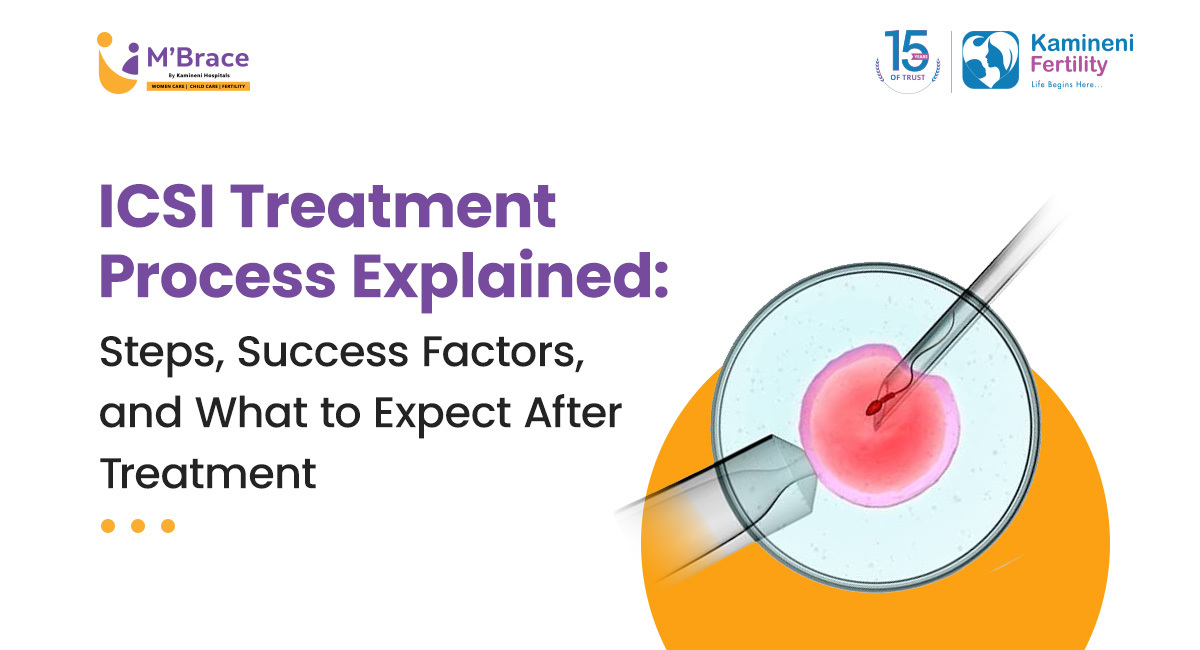
You've probably just heard the word ICSI from your doctor, and now you're wondering what actually happens once you walk into the lab, and whether it will really work for you.
We at Kamineni Fertility collect your eggs and your partner's sperm. Then our embryologist injects one healthy sperm straight into each mature egg, under a microscope, in an in-house lab. We watch the embryo grow for a few days. Then place it back into your uterus.
Our embryology team at Kamineni Fertility has done this for over 15 years. We're an ICMR-recognised fertility centre in Hyderabad, and have helped deliver 14,000+ babies along the way. Now let's walk through each step of the ICSI treatment process.
What Are the Steps in the ICSI Treatment Process?
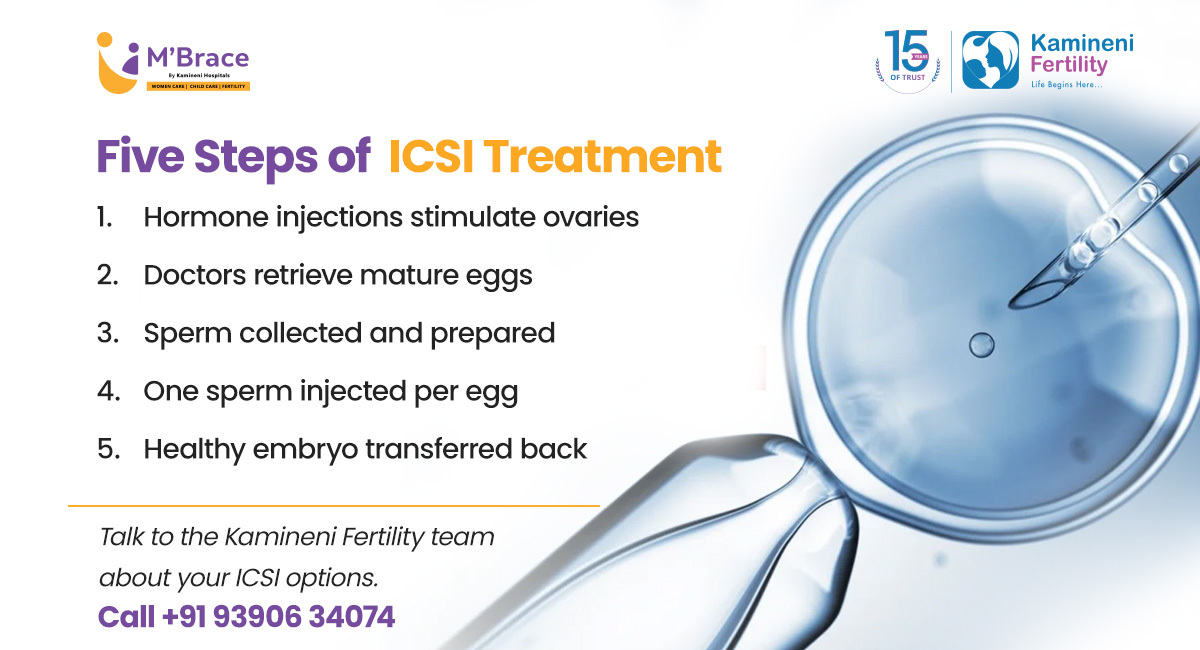
Five main stages make up the ICSI process: stimulating your ovaries, collecting the eggs and sperm, the injection itself, growing the embryo, and the final transfer. Each stage builds on the last, and the team at the best fertility hospital in Hyderabad monitors the process closely.
1. Ovarian Stimulation and Monitoring
Your doctor prescribes hormone injections for around 10 to 12 days to help your ovaries produce several mature eggs. Regular ultrasounds and blood tests track follicle growth.
2. Egg Retrieval and Sperm Collection
A thin needle, guided by ultrasound, collects the mature eggs directly from your ovaries. On the same day, a semen sample is collected and processed in the lab.
3. The ICSI Injection in the Lab
Under a high-magnification microscope, an embryologist selects one healthy sperm and injects it directly into the cytoplasm of a mature egg. This is repeated for each egg collected.
4. Embryo Culture and Grading
The fertilised eggs move into incubators designed to mimic conditions inside the body. Over the next three to five days, embryologists check growth daily and grade each embryo on cell division and structure to identify the strongest candidates.
5. Embryo Transfer
The best quality embryo, or occasionally two, is loaded into a thin catheter and placed into your uterus.
That's the whole ICSI treatment process, start to finish. Each stage exists to protect embryo quality.
Talk to the Kamineni Fertility team about your ICSI options. Call 09390634074.
What Factors Affect ICSI Treatment Success?
ICSI treatment success factors depend on several things working together, not on the procedure alone. Your age, egg and sperm quality, embryo development, and uterine health all play a part, and your specialist will assess each one from your reports before your cycle begins.
- Age: Age affects egg quality, which shapes fertilisation and embryo development. Egg quality naturally shifts over the years.
- Sperm quality: ICSI bypasses the sperm's usual journey to the egg, but it does not change whether that sperm carries healthy genetic material.
- Egg quality and ovarian reserve: These influence how well an egg responds to the injection and fertilises.
- Embryo quality: How well the fertilised egg divides and reaches the blastocyst stage shapes implantation chances later on.
- Uterine health: Conditions such as fibroids or a thin uterine lining can affect whether an embryo implants successfully.
- Lifestyle factors: Smoking, alcohol and body weight can play a supporting role, though they rarely act alone.
- Lab and embryology expertise: Precision during injection and consistent culture conditions directly influence fertilisation rates.
Results vary between individuals, and outcomes depend on your specific diagnosis. Kamineni Fertility specialists walk you through these factors honestly, so you know what to expect rather than guess.
What Should You Expect After ICSI Treatment?
After embryo transfer, most patients enter a two-week wait before a blood test confirms whether implantation has happened. This period usually involves hormonal support medicines, ordinary daily activity, and a fair amount of patience.
| After ICSI | What to Expect |
|---|---|
| The two-week wait | Mild cramping, light spotting or bloating can be normal. Continue your prescribed progesterone support exactly as advised. |
| Beta hCG blood test | Around 12 to 14 days after transfer, a blood test checks hCG hormone levels to confirm pregnancy. This is far more reliable than testing at home. |
| When to contact the fertility team | Heavy bleeding, severe pain, fever or anything that simply feels wrong should not wait for your scheduled test. Call your clinic directly. |
It's normal to feel anxious, check for symptoms constantly, or swing between hope and doubt during ICSI treatment in Hyderabad. You do not have to sit with that alone. Talk to your partner, a counsellor, or our fertility team.
Why Choose Kamineni Fertility for ICSI in Hyderabad?
Kamineni Fertility offers one of the best ICSI treatments in Hyderabad, backed by an ICMR-recognised lab, an experienced doctor-led team, and over 15 years of clinical experience.
Our fertility specialists, including Dr. Vasundhara Kamineni, Dr. Seeram Lakshmi, Dr. Sarika Mudarapu and Dr. M. Sri Latha, work closely with our embryology team to plan each ICSI treatment around your specific diagnosis.
Whether you're exploring the best IUI treatment near me for the first time or seeking a second opinion, our doctors explain your reports simply before any treatment begins.
Book a fertility evaluation at Kamineni Fertility. Call: 09390634074.
- King Koti Branch: 4-1-1226, Boggulakunta, King Koti, Abids, Hyderabad - 500001
- L B Nagar Branch: OP No. 8, Kamineni Hospitals, L B Nagar, Hyderabad - 500068. Accessible via L B Nagar Metro Station.
- Call us: +91 93906 34074
Disclaimer: This content is for informational purposes only and does not replace medical advice. Please consult a qualified fertility specialist for personalised guidance on ICSI, IVF, IUI or any fertility treatment.
Frequently Asked Questions
How long does the ICSI process take from start to finish?
About two to three weeks, start to finish. It depends on how quickly you respond to the stimulation medication, so your exact timeline can shift a little.
Is ICSI more painful than IVF?
Not really. The injection itself happens in the lab, not inside you. Egg retrieval is done under sedation, so most women just feel mild soreness afterwards.
Does ICSI guarantee pregnancy?
No treatment can promise that. ICSI improves fertilisation chances, but egg quality, sperm quality and your uterine health all still matter.
How is ICSI different from IUI?
IUI places sperm inside the uterus and lets nature take over. ICSI injects one sperm directly into the egg. Many searching for IUI treatment near me try IUI first.
What happens if fertilisation fails after ICSI?
It happens occasionally, even with a healthy sperm and egg. We'll walk you through exactly why, and talk through your options for the next cycle.
How soon can we know if ICSI treatment worked?
Around 12 to 14 days after transfer, a blood test checks your hCG levels. It's the most reliable way to know, even though the wait feels endless.
Click Here to get more information on:
ICSI Treatment in Hyderabad
IUI Treatment in Hyderabad
Book Your Fertility Evaluation
For inquiries/ appointment, call us on:
 +91 93906 34074