IVF Success Rate by Age: What Are Your Chances of Success in 2026?
IVF success rates by age range from 40 to 50% for women under 35, dropping to 25 to 35% between 38 and 40 and 10 to 20% for women over 40 per transfer cycle. These figures come from published clinical data and vary based on your diagnosis, ovarian reserve and clinic quality.
You are considering IVF treatment but confused about what these numbers actually mean for you. Fertility clinics offer their best figures. They do not explain how those numbers change with age, what they mean per IVF cycle or what your real cumulative chances look like across two or three IVF cycles. That gap is where decisions go wrong.
Here is what they do not tell you. A 40% rate means 4 out of 10 transfer cycles result in a confirmed pregnancy. Across multiple IVF cycles, cumulative rates are significantly higher.
At Kamineni Fertility, an ICMR-recognised IVF hospital in Hyderabad with 15+ years of experience and 17,000+ cases handled, our specialists at King Koti and L B Nagar review your complete clinical picture and build a protocol around your situation, not a standard one.
All figures for IVF Success Rate by Age on this page come from published clinical data. They are ranges, not guarantees. Your individual chances depend on your diagnosis, ovarian reserve, sperm health and the quality of the clinic you choose.
What Do IVF Success Rates Actually Mean?
An IVF success rate is the proportion of transfer cycles that result in a confirmed pregnancy at a given clinic. It is not the proportion of women who take home a baby. Most clinics show you the clinical pregnancy rate. The number that actually matters is the live birth rate and those two figures are never the same.
Clinical Pregnancy Rate vs Live Birth Rate
The clinical pregnancy rate counts every pregnancy confirmed by a scan at six to seven weeks. The live birth rate counts only the babies who were actually born. Some pregnancies that show on a scan miscarry before birth. That is why the live birth rate is always lower.
For example, a clinic with a 45% clinical pregnancy rate may have a live birth rate of 35 to 38%. That gap matters when you are making a decision.
For women under 35, the gap between the two figures is typically 5 to 10%. For women over 38, it widens because miscarriage rates rise with age.
When you speak to any clinic, ask for both numbers. The clinical pregnancy rate tells you how often a pregnancy starts. The live birth rate tells you how often a baby is born. You need both to make a fair comparison.
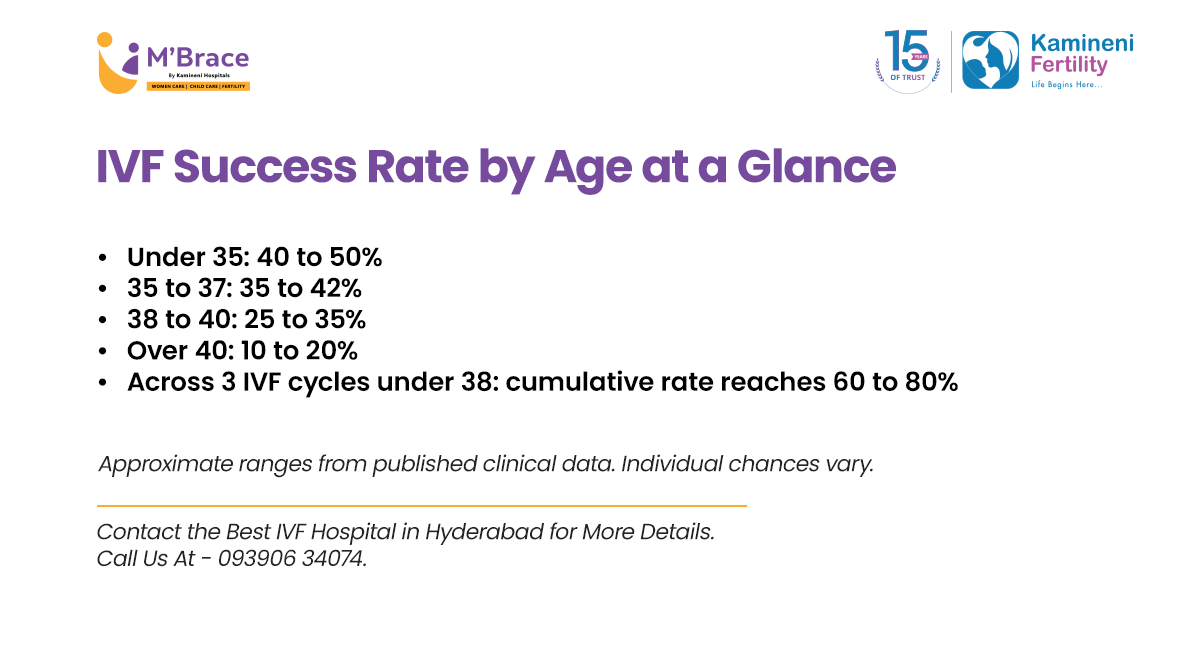
IVF Success Rate by Age: What the Data Shows in 2026?
Age is the single biggest factor in IVF success. Not because of how many eggs you have, but because of their quality. As you get older, egg quality declines. Fewer eggs fertilise successfully, fewer embryos develop properly and more pregnancies miscarry before birth.
The national average IVF success rate in India in 2025 is approximately 40 to 55% per IVF cycle for women under 35 at ICMR-accredited centres. The table below shows what the data looks like across all age groups.
| Age Group | Typical Rate Per IVF Transfer | Key Driver |
|---|---|---|
| Under 35 | 40 to 50% | Strong egg quality and ovarian response |
| 35 to 37 | 35 to 42% | Egg quality decline begins |
| 38 to 40 | 25 to 35% | Noticeable drop in quality and reserve |
| Over 40 | 10 to 20% | Significant decline, higher miscarriage risk |
IVF Success Rate Under 35
This age group has the highest IVF success rates and typically the best response to stimulation medications. More eggs are retrieved, more fertilise successfully and embryo development rates are stronger. Women under 35 often produce more embryos than they need in one IVF cycle. Extra embryos can be frozen and used in future transfers without going through stimulation again, extending the value of a single egg retrieval.
IVF Success For Age 35 to 37
Success rates are still good but the decline in egg quality is measurable. More retrieved eggs fail to fertilise or develop into a viable embryo compared to the under-35 group. Preimplantation Genetic Testing (PGT) screens embryos for chromosomal problems before transfer. Choosing a healthy embryo with normal chromosomes for transfer improves success rates and lowers miscarriage risk. This becomes more relevant from 35 onwards.
IVF Success For Age 38 to 40
The decline between 37 and 40 is steeper than most women expect. Fewer eggs respond to stimulation and fewer of those eggs produce embryos capable of implanting. The stimulation protocol your doctor uses matters more at this stage than at any other. A standard dose can be too much for one patient and not enough for another. Doctors who adjust doses based on your AMH test result and the number of resting follicles visible on your scan, checked before your IVF cycle begins, consistently retrieve better quality eggs than those using a fixed approach.
IVF Success Rate Over 40
After 40, chromosomal abnormalities in eggs increase significantly. Most embryos retrieved in this group either fail to implant or result in miscarriage rather than a live birth. Donor egg IVF changes this picture completely. It uses eggs from a younger, screened donor fertilised with your partner's sperm. Success rates with donor eggs are comparable to the under-35 group, regardless of how old the recipient is. For many women over 40, this is how their first successful IVF outcome happens.
What Is the Actual IVF Success Rate in India?
India performs over two lakh IVF cycles every year, making it one of the largest fertility treatment markets in the world. The IVF success rate in India varies significantly between clinics and that variation is the most important thing to understand before you choose where to go.
At ICMR-recognised centres that follow regulated protocols and maintain proper lab standards, success rates align with the age-band figures shown above. At centres that do not meet these standards, they do not. One investigation found that in the absence of centralised data, some clinics in India claim success rates far higher than their actual outcomes.
The difference between a good outcome and an average one in India comes down to four things:
- Embryology Lab Quality: Temperature control, equipment standards and embryologist experience directly affect how embryos develop between retrieval and transfer.
- Stimulation Protocol: A protocol personalised to your AMH level and follicle count consistently outperforms a standard one.
- Embryo Selection: The grading system and criteria used to select which embryo to transfer matters significantly.
- Clinical Experience: A team that has handled complex cases across thousands of IVF cycles reads your results differently than one that has not.
The figure a clinic quotes is less important than whether the clinic can explain what drives it. An ICMR-recognised IVF centre in Hyderabad with a documented track record gives you a verifiable baseline. A number on a brochure without that context does not.
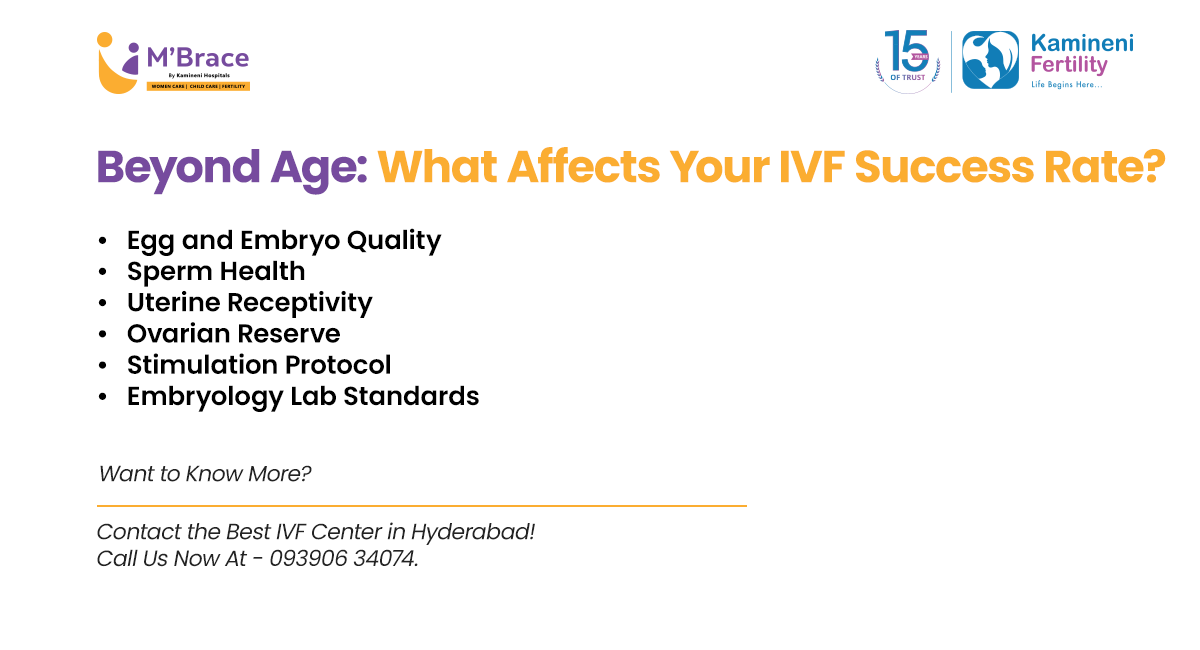
Age is the strongest predictor of IVF success, but it is not the only one. Several other factors shape what happens in your IVF cycle, some fixed and some within your control.
- Egg and Embryo Quality: Even two women of the same age can produce embryos of very different quality. How many eggs fertilise, how many develop to blastocyst stage and what grade those embryos reach all influence whether the transfer succeeds.
- Sperm Health: Count, movement and shape all affect fertilisation rates in your IVF cycle. If sperm quality is significantly affected, ICSI is used. A single sperm is injected directly into the egg rather than leaving fertilisation to chance in a dish.
- Uterine Receptivity: The embryo needs a lining that is thick enough and ready to receive it. Fibroids, polyps or a thin lining reduce implantation rates regardless of how good the embryo is.
- Ovarian Reserve: Your AMH level and the number of resting follicles seen on your scan tell your doctor how many eggs are available to stimulate in that IVF cycle. A low reserve does not rule out IVF but it changes how your stimulation protocol is designed.
- Stimulation Protocol: The right medication, at the right dose, for your specific ovarian response affects how many eggs are retrieved in your IVF cycle and their quality. This is not the same for every patient.
- Lab Standards: After egg retrieval, fertilisation and embryo development happen entirely inside the embryology lab. The temperature, humidity, oxygen levels and equipment in that lab directly affect whether your embryos survive and develop to a stage where they can be transferred.
What Can You Actually Do to Improve Your IVF Success Rate Chances?
Some factors are fixed: your age, your ovarian reserve and your diagnosis. But several are within your reach and they make a real difference to how your IVF cycle performs.
Before Starting Your IVF Cycle:
- Get a Full Fertility Evaluation First: Your stimulation protocol should be based on your actual AMH level, follicle count, hormone panel and uterine assessment, not a standard template applied to every patient.
- Address Insulin Resistance If You Have PCOS: Insulin resistance affects egg quality and ovarian response during stimulation. Managing it before your IVF cycle begins improves the quality of eggs your body produces.
- Optimise Sperm Health Three Months Before: Sperm takes approximately three months to develop. A semen analysis and targeted lifestyle changes three months before your IVF cycle gives your partner's sperm the best chance of producing healthy embryos.
- Maintain a Healthy Weight: Both significant underweight and overweight affect how your ovaries respond to stimulation and how well the embryo implants in your IVF cycle.
During Your IVF Stimulation Phase:
- Attend Every Monitoring Scan: Your doctor adjusts your medication dose based on how your ovaries are responding during your IVF cycle. Missing a scan means missing the chance to course-correct while there is still time.
- Avoid Intense Exercise: Your ovaries enlarge significantly during stimulation as follicles grow. Vigorous physical activity during this phase increases discomfort and carries a small risk of ovarian torsion.
- Stop Smoking and Limit Alcohol: Both directly reduce egg quality and embryo development rates during your IVF cycle.
What Happens If the First IVF Cycle Does Not Work?
One unsuccessful IVF cycle does not mean IVF will not work for you. It means your doctor now has real data from your specific IVF cycle. How your ovaries responded to stimulation, how many eggs fertilised, how your embryos developed and whether the transfer resulted in implantation. That data makes the next IVF cycle more informed than the first.
For women under 38, cumulative success rates across three IVF cycles at quality centres reach 60 to 80% in published data, significantly higher than any single IVF cycle figure. Each IVF cycle that produces embryos suitable for freezing also extends your options. Frozen embryos can be transferred in a future cycle without repeating the full stimulation process.
After an unsuccessful IVF cycle, your doctor should review:
- Egg Retrieval Numbers: How many eggs were collected and how many fertilised successfully.
- Embryo Development: What grades the embryos reached and whether any developed to blastocyst stage.
- Endometrial Receptivity: Whether the uterine lining was thick enough and ready at the time of transfer.
- Protocol Adjustment: Whether the stimulation dose, medication type or transfer timing should change in the next IVF cycle.
Speak to an IVF Specialist at Kamineni Fertility, Hyderabad
IVF success rates are averages. Your chances depend on your specific clinical picture, not a number on a page. A consultation at Kamineni Fertility tells you exactly what your picture looks like before you commit to anything.
As the best IVF hospital in Hyderabad, Kamineni Fertility brings 15+ years of IVF experience, advanced embryology labs and ICMR-recognised protocols to every patient. Our specialists at King Koti and L B Nagar evaluate your ovarian reserve, sperm health, uterine condition and diagnosis together before recommending a protocol built specifically for your IVF cycle.
If you have been searching for a trusted IVF centre in Hyderabad or an IVF hospital in Hyderabad with a documented track record, both our branches are ready for you.
- King Koti Branch: 4-1-1226, Boggulakunta, King Koti, Abids, Hyderabad - 500001
- L B Nagar Branch: OP No. 8, Kamineni Hospitals, L B Nagar, Hyderabad - 500068
Book your IVF consultation at Kamineni Fertility. Call us now at 093906 34074.
Disclaimer: IVF success rates vary significantly based on individual health factors including age, diagnosis, ovarian reserve, sperm quality and embryo development. The figures cited in this content are approximate ranges from published clinical data and do not represent guaranteed outcomes or clinic-specific results. Please consult a qualified fertility specialist for personalised guidance.
Frequently Asked Questions
What is a good IVF success rate to look for in a clinic?
Ask for live birth rates, not just clinical pregnancy rates. A reputable clinic shows both and explains what drives the difference. ICMR recognition is the baseline quality indicator for fertility centres in India.
Does IVF work on the first try?
Sometimes. Most couples who achieve pregnancy through IVF do so across two to three IVF cycles. One unsuccessful IVF cycle gives your doctor data that makes the next attempt more targeted.
Is IVF success rate the same as live birth rate?
No. Clinical pregnancy rate counts pregnancies confirmed by scan. Live birth rate counts babies actually born. The live birth rate is always lower. Always ask for both when evaluating a clinic.
Can lifestyle changes improve IVF success?
Yes, within limits. Managing weight, stopping smoking, limiting alcohol, treating insulin resistance and optimising sperm health all contribute to better outcomes in your IVF cycle. They do not override age-related decline but they improve the quality of eggs and embryos available.
What is the IVF success rate for women over 40?
Approximately 10 to 20% per IVF transfer cycle using your own eggs, based on published clinical data. Donor egg IVF produces significantly higher rates because the eggs come from a younger donor. Your doctor will discuss both options based on your ovarian reserve and diagnosis.
Is IVF treatment available at Kamineni Fertility in Hyderabad?
Yes. Kamineni Fertility offers complete IVF treatment in Hyderabad at both King Koti and L B Nagar, including personalised stimulation protocols, ICSI, blastocyst transfer, embryo freezing and full post-cycle support. Call 093906 34074 to book your consultation at the best IVF hospital in Hyderabad.
Click Here to get more information on:
IVF Consultation
Book Your IVF Consultation
For inquiries/ appointment, call us on:
 +91 93906 34074