IVF vs Surrogacy: Key Differences, Costs, and When to Choose Each (2026 Guide)
For couples struggling to conceive, choosing between IVF and surrogacy can feel overwhelming. Both options offer hope, but they are designed for very different medical situations. Understanding which path is right for you begins with understanding your diagnosis, emotional readiness and medical possibilities.
At Kamineni Fertility, one of the best IVF hospitals in Hyderabad with 15+ years of experience and thousands of cases handled, this is one of the most common questions couples bring to their first consultation. This guide covers the difference between IVF and surrogacy, the key IVF benefits, and how to know which path applies to your situation.
What Is the Difference Between IVF and Surrogacy?
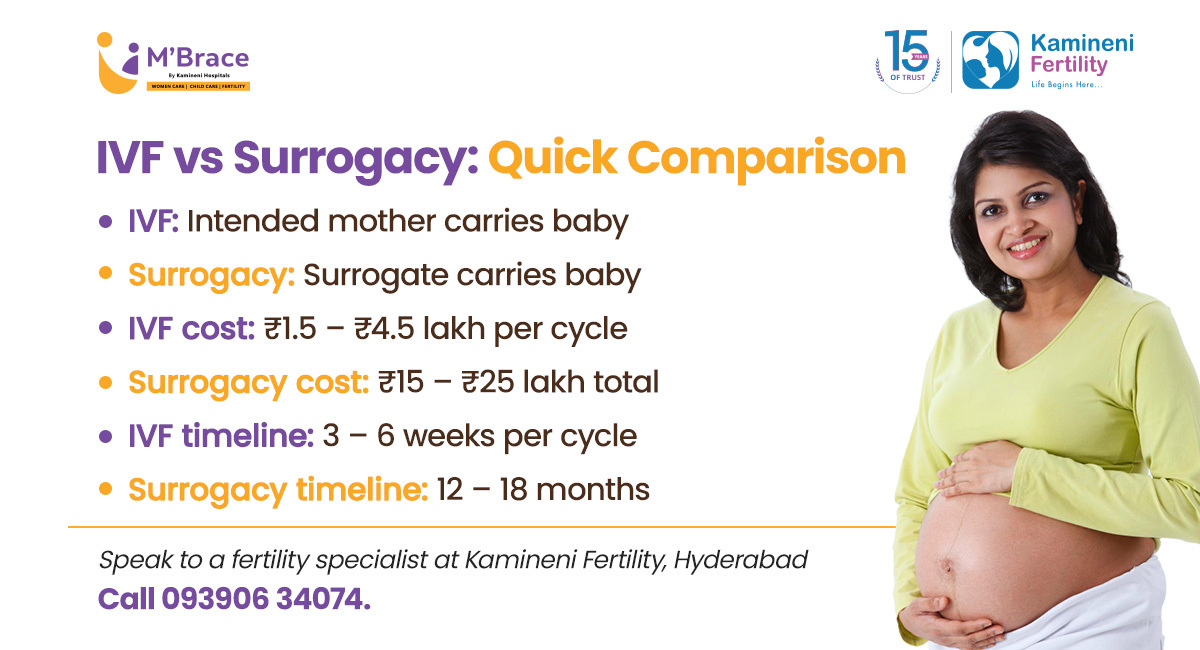
The core difference between IVF and surrogacy is who carries the pregnancy. In IVF, the intended mother carries the baby. In surrogacy, another woman carries the pregnancy for the intended parents.
IVF and surrogacy are not interchangeable. IVF is a fertility treatment. Surrogacy is a legal and medical arrangement involving a third person.
What Is IVF?
In Vitro Fertilisation (IVF) is a treatment where eggs are collected from the woman's ovaries, fertilised with sperm in a laboratory, and the resulting embryo is placed into her uterus. The intended mother carries and delivers the baby herself.
India performs approximately 2 to 3 lakh IVF cycles annually, making it one of the most active fertility treatment markets in the world. IVF treatment in Hyderabad has become increasingly accessible, with fertility clinics offering advanced lab infrastructure alongside personalised care.
What Is Surrogacy?
Surrogacy is an arrangement where a surrogate carries the embryo formed from the intended parents' eggs and sperm. The surrogate has no genetic connection to the child in gestational surrogacy.
As of 2026, only altruistic surrogacy is legally permitted in India under the Surrogacy (Regulation) Act, 2021. The surrogate cannot receive financial compensation beyond verified medical expenses.
IVF vs Surrogacy: At a Glance
| Factor | IVF | Surrogacy |
|---|---|---|
| Who carries the baby | Intended mother | A surrogate woman |
| Used when | Woman can carry a pregnancy | Woman medically cannot carry a pregnancy |
| Genetic connection | Intended parents' own eggs/sperm | Intended parents' own eggs/sperm |
| Legal process required | No | Yes, mandatory in India |
| Typical timeline | 3 - 6 weeks per cycle | 12 - 18 months |
Who Needs IVF and Who Needs Surrogacy?
Most couples who visit a fertility clinic in Hyderabad are candidates for IVF first. Surrogacy is considered only when carrying a pregnancy is medically not possible. A basic fertility evaluation identifies the exact cause and determines the right path.
IVF Is Usually Recommended When:
- Fallopian tubes are blocked or damaged
- Sperm count, movement or shape is poor
- Polycystic Ovary Syndrome (PCOS) is affecting ovulation
- Endometriosis is present
- Previous IUI treatment cycles have not resulted in pregnancy
- Ovarian reserve is low
- Infertility is unexplained
Surrogacy May Be Considered When:
- The uterus is absent or has been surgically removed
- A severe uterine condition such as Asherman's syndrome is present
- IVF has been attempted multiple times without implantation occurring
- Carrying a pregnancy poses a serious medical risk, such as advanced cardiac or kidney disease
- Recurrent miscarriages have occurred with no identifiable or treatable cause
If your uterus can support a pregnancy, IVF comes first. Surrogacy is a medically indicated path, not an alternative preference.
What Does the IVF Process Involve?
One cycle of IVF treatment in Hyderabad takes 3 to 6 weeks. Here is what usually happens:
- Ovarian stimulation: Hormonal injections help the ovaries produce multiple eggs.
- Ultrasound monitoring: Scans and blood tests track egg development throughout.
- Egg retrieval: Mature eggs are collected under mild sedation.
- Fertilisation: Eggs are combined with sperm in the lab. When sperm quality is poor, ICSI may be used.
- Embryo development: Embryos grow in the lab for 2 to 5 days.
- Embryo transfer: One or more embryos are placed into the uterus.
- Pregnancy test: A blood test 14 days later confirms if implantation has occurred.
Women under 35 may achieve success rates of approximately 50 to 60% per cycle, depending on embryo quality, ovarian reserve and underlying fertility factors. After 40, rates can fall below 20%. This is why early evaluation at the best IVF hospital near me makes a measurable difference to outcomes.
What Are the Advantages of IVF Over Other Fertility Treatments?
IVF benefits couples across a wide range of fertility conditions, which is why it is the most widely recommended assisted reproductive treatment before surrogacy is considered.
- Works for both male and female fertility causes
- Lab-based fertilisation improves precision
- Can be combined with ICSI when sperm quality is poor
- Genetic screening is possible through PGD and PGS
- Unused embryos can be frozen for future cycles
- Allows intended parents to experience pregnancy and childbirth themselves in many cases
- Cumulative success may improve over multiple cycles
Does Failed IVF Mean You Need Surrogacy?
Not necessarily. Many couples conceive successfully after adjusting the IVF protocol, improving embryo quality through additional evaluation, or identifying and treating an underlying condition that was affecting implantation.
Surrogacy is usually considered only when pregnancy cannot be safely carried, or when implantation repeatedly fails despite multiple medically optimised IVF attempts. It is not the automatic next step after one or two unsuccessful cycles.
IVF Success Rates in India by Age (2026)
- Under 35: 50 - 60% per cycle
- 35 to 37: 40 - 50% per cycle
- 38 to 40: 25 - 35% per cycle
- Above 40: 10 - 20% per cycle
- Cumulative rate after 3 cycles: Up to 60 - 75%
Emotional and Physical Differences Between IVF and Surrogacy
IVF and surrogacy place very different demands on the couple, physically and emotionally.
With IVF, the intended mother:
- Undergoes hormonal stimulation, egg retrieval and embryo transfer herself
- May experience bloating, mood changes and fatigue during stimulation
- Faces the emotional intensity of the two-week wait after embryo transfer
- May need more than one cycle, with cumulative success potentially improving over attempts
With surrogacy, the intended mother:
- Does not carry the pregnancy physically
- Navigates legal approvals, surrogate matching and a 12 to 18 month timeline
- Carries significant emotional weight in trusting someone else with the pregnancy
Both paths require honest counselling and a clinic team that does not rush decisions.
Is Surrogacy Legal in India, and Who Qualifies?
Yes, altruistic surrogacy is legal under the Surrogacy (Regulation) Act, 2021 and the 2024 amendment. Commercial surrogacy is completely banned.
Who is eligible:
- Married Indian heterosexual couples, married for at least five years, with a confirmed medical indication
- Widowed or divorced Indian women within prescribed age limits, under specific conditions
Who is not eligible:
- Same-sex couples
- Single men
- Foreign nationals
All arrangements require district-level legal approvals before any medical treatment begins. If surrogacy has been advised for your situation, consult both a fertility specialist and a legal adviser familiar with India's ART regulations.
What Factors Affect IVF Success Rates?
IVF success rates are not fixed numbers. They shift based on a combination of medical, biological and lifestyle factors.
| Factor | Why It Matters |
|---|---|
| Woman's age | Egg quality and quantity decline with age, directly affecting success. |
| Egg quality | Poor egg quality reduces fertilisation and embryo development chances. |
| Sperm quality | Count, motility and morphology all affect fertilisation in the lab. |
| Embryo quality | How well embryos develop to day 3 or day 5 determines transfer suitability. |
| Uterine health | The endometrial lining must be receptive for implantation to occur. |
| Ovarian reserve | A lower egg count reduces the number of embryos available per cycle. |
| Body weight | Being significantly over or underweight can affect hormone response and outcomes. |
| Diabetes and health conditions | Uncontrolled blood sugar and metabolic conditions can impair egg and embryo quality. |
| Smoking and alcohol | Both negatively affect egg quality, sperm health and uterine receptivity. |
| Clinic and lab quality | Embryology lab standards, culture conditions and protocol expertise directly influence results. |
Your doctor at Kamineni Fertility will assess all relevant factors before recommending a protocol. Treatment decisions are always based on your specific reports, not population averages.
Take the Next Step at Kamineni Fertility, Hyderabad
IVF and surrogacy address two different medical situations. Most couples start with IVF, and the decision to explore surrogacy follows careful evaluation and legal guidance. If you are unsure which path applies to you, begin with a fertility evaluation at Kamineni Fertility, a trusted IVF centre in Hyderabad.
As one of the best IVF hospitals in Hyderabad, backed by 15+ years of experience and thousands of babies delivered, we offer IVF treatment in Hyderabad, ICSI, IUI, Natural Cycle IVF and Ovulation Induction at King Koti and L B Nagar. Every plan is built on your diagnosis alone.
- King Koti: 4-1-1226, Boggulakunta, King Koti, Abids, Hyderabad 500001
- L B Nagar: OP No. 8, Kamineni Hospitals, L B Nagar, Hyderabad 500068
Book a consultation or call 093906 34074. Results vary from person to person. No treatment guarantees pregnancy.
This content is for informational purposes only. Please consult a qualified fertility specialist for personalised medical guidance.
Frequently Asked Questions
Can a woman with PCOS or endometriosis carry a pregnancy through IVF?
Yes, in many cases. PCOS and endometriosis can affect ovulation and egg quality, but they do not always prevent a woman from carrying a pregnancy. Your doctor will assess the severity of the condition and recommend a suitable treatment plan. IVF or Ovulation Induction may be considered depending on your diagnosis.
How many IVF cycles does it typically take to conceive?
There is no fixed number that applies to everyone. Some couples conceive in the first cycle; others may need two or three attempts. Your doctor will review each cycle, adjust the protocol if needed, and guide you on the most appropriate next step based on your response to treatment.
Does the surrogate have any legal claim over the baby in India?
No. Under the Surrogacy (Regulation) Act, 2021, the surrogate has no legal claim over the child. A Parentage Order passed by a First Class Magistrate formally establishes the legal parentage of the intended parents before or at the time of birth.
What tests are done before starting IVF treatment?
Before IVF begins, both partners undergo a fertility evaluation. This typically includes a semen analysis, hormonal blood tests, an ultrasound to check ovarian reserve and uterine health, and sometimes additional tests depending on your medical history.
Is the baby born through surrogacy genetically related to the intended parents?
In gestational surrogacy, which is the only type permitted in India, the embryo is created using the eggs and sperm of the intended parents or a donor. The surrogate carries the pregnancy but has no genetic connection to the child.
Click Here to get more information on:
IVF at Kamineni Fertility
Natural Cycle IVF at Kamineni Fertility
For inquiries/ appointment, call us on:
 +91 93906 34074